

When trust is thin between marketing, Sales and Product, the usual fix is another alignment meeting.
Marketing walks through the plan. Sales explains which leads they can actually use. Product flags a date or a claim they can’t stand behind. Actions get written down. Two weeks later the same friction is back, and someone suggests a standing weekly to “keep us aligned.”
The meeting is the wrong tool. Trust is built when the other team can see, in the work, that you understood their world, involved them while something could still change, and came back to tell them what happened. You don’t need a new recurring meeting for that. You need a few habits on the project that’s already underway:
- Write down what “good” means for this project, and get a yes on it.
- Invite early, with a draft and one question.
- Write things the other team can use without you.
- Close the loop after it ships.
Below: what each habit looks like, a weak and a stronger version of the messages involved, and a walk-through of all four on one project.
What trust looks like from the outside
“We have a good relationship” isn’t a useful test. People notice trust in smaller, more concrete ways:
- Sales uses your talk track or email copy on a call without rewriting the claim.
- Product sends you the scoping note while the feature can still change, not after it’s locked.
- Someone tells you a date slipped in time for you to adjust.
- They put your numbers in their own update, with the source still attached.
If those things aren’t happening, more time in a room together usually doesn’t create them. A short conversation can still settle a definition or a claim. A recurring meeting shouldn’t be the relationship.
1. Write down what “good” means for this project
A shared definition beats a shared calendar hold. For a demand campaign, that might be what Sales will treat as a qualified lead, and what they won’t. For a launch, it might be which claims Product will stand behind on day one, and what “ready” actually means: still in beta or generally available, which plan it’s on, what still needs a workaround.
Keep it short: a few lines in a note, not a workshop. Get a yes before you build the campaign around an assumption. When the definition gets tested later, by a lead Sales has to pass on or a sentence Product can’t defend, you have something to update together instead of a vague memory of what was “aligned.”
If the definition lives in a brief, check it the way you’d check any brief: hand it to someone from the other team and run the playback test. If they can’t play back what “good” means, it isn’t shared yet.
2. Invite early with a draft and one question
“Let me know if you have feedback,” sent with a finished deck three days before launch, isn’t an invitation. It’s a courtesy copy. By then the honest answers are “looks good” or “this will cause a problem,” and only the second one is expensive enough to say out loud.
Here’s the difference in practice. This example is illustrative.
Weak:
Hi all, attaching the launch emails. Let me know if you have any feedback by Thursday!
Stronger:
Here’s a draft of the first three trial emails. One question for Sales: when a trial user goes quiet, what do they tell you is in the way? I’d like the first email to answer that. One question for Product: can you stand behind the second sentence of email 2 on launch day? I can still change both this week.
The draft matters because people give better input on a thing than on a plan. One specific question gets answered; a general request for “thoughts” often doesn’t. If the answer can still change the work, you asked early enough. If it can’t, you asked for approval, not for help.
3. Write things the other team can use without you
If your work only makes sense when you’re in the room to explain it, it won’t get used. A one-page launch note Sales can keep open during a demo, a short list of claims Product has signed off on, a definition of the offer that Customer Success can paste into a ticket: those travel.
The test is simple. Could someone on the other team use this tomorrow without messaging you for the “real” version? That’s how you avoid the meeting that went well and the enablement doc that never ships.
4. Close the loop after it ships
The fastest way to spend down trust is to ask for help and never report back. After the campaign or launch, send a short note to the people who contributed: what you were aiming for, what happened (with sources), what you’d change, and one implication for their work. Include the uncomfortable parts. A loop that only closes when the numbers look good teaches people that marketing goes quiet when things get messy.
This is easier if you wrote down what you expected before launch. A five-line decision record gives you the “what we expected” half of the note before the results come in.
Again, illustrative:
Weak:
Launch went well, thanks everyone for your help!
Stronger:
Closing the loop on the trial emails. We aimed to get more trial users to start a first project. Here’s what happened, with the source and date range for each number. Sales, your answer about project types changed the first email; here’s whether that objection came up less. Product, we dropped the time claim and nobody asked for it back. Next release, I’d bring you both the draft a week earlier.
Send the note while the project is still fresh. The next time you ask for early input, they’re deciding based on whether the last loop closed.
How this looks on a project (hypothetical example)
This example is hypothetical, and the metrics are placeholders.
A lifecycle marketer is writing the trial email sequence for a new guided-setup assistant. Product is shipping the feature. Sales is already hearing from trial users who never start a first project.
The version that stays stuck: marketing writes the sequence from the product brief and books a 45-minute alignment meeting the week before launch. Sales says the setup claims don’t match what they hear on calls. Product mentions the date may move. The meeting ends with “let’s stay close.” The emails go out mostly as written. Sales stops forwarding what they hear. Product stops flagging date changes early.
The version that earns trust: mid-project, marketing asks Sales one question: when a trial user goes quiet, what do they say is getting in the way? Sales says people don’t know which project type to start with. The first email and the in-app note now lead with “the assistant picks a starting project type for you.”
Marketing sends Product the exact sentences they want to publish, including a time-to-setup claim. Product won’t stand behind a time claim while the assistant is still in beta, but they will stand behind the starting-project-type line. The time claim comes out, and the rewrite is checked before anything is scheduled.
Then the release date moves by two weeks. Marketing holds the launch emails, puts a short “coming soon” note in the trial, and uses the extra time to have Sales try the new talk track against recent calls. The sequence is rebuilt against the new date.
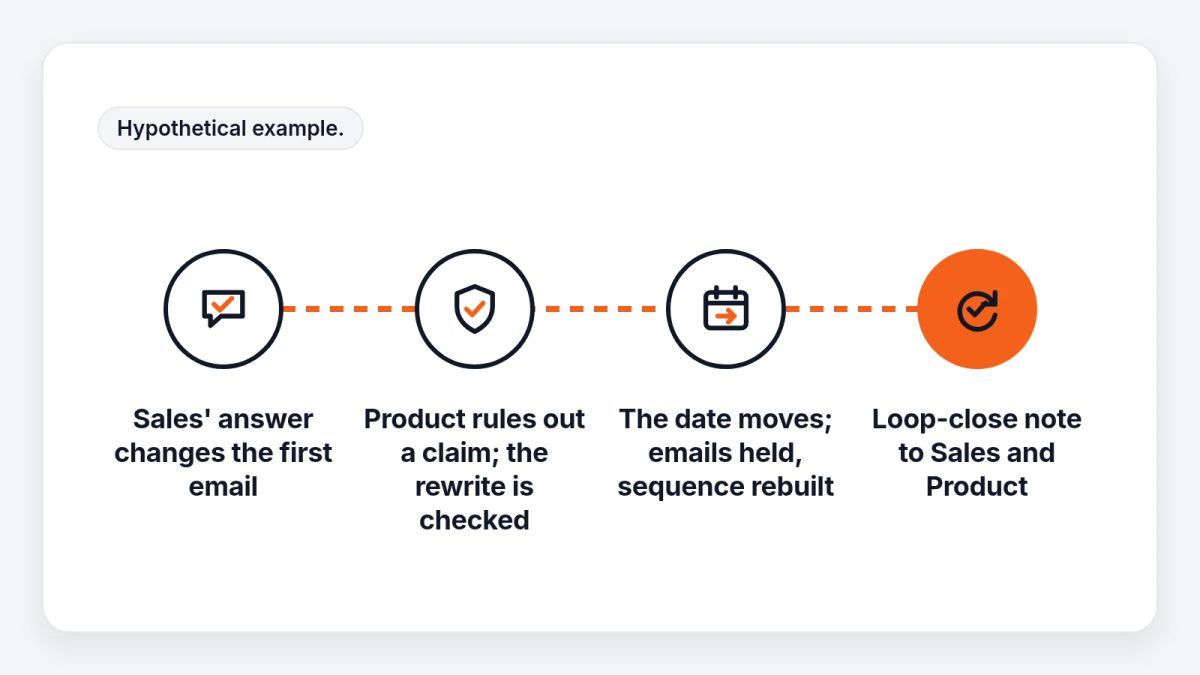
After launch, marketing sends Sales and Product a note: the shared result ([team metric, source, window]); what the sequence itself did ([channel metric, source]); whether the setup objection came up less; and one change for the next release.
The difference isn’t more meetings. Sales can see their input in the work. Product can see a constraint respected rather than bargained away. Both can see what happened after they helped.
What to do next
Pick one live project that already involves Sales or Product.
- Write five lines on what “good” means for this campaign or launch, and get a yes from the other team.
- Send one draft with one specific question, early enough that the answer can still change the work.
- Turn the useful parts into something that travels: a one-pager, a signed-off claim list, a talk track.
- When it ships, close the loop in writing, including what you’d change.
If you only do one thing, send the early draft with one question. Don’t start a new standing meeting to kick this off. Use the project that’s already on the calendar.