


“Use your judgment” (or its cousin, “be more strategic”) rarely comes with instructions.
You hear it when a campaign goes sideways, when you ask too many questions, or when you ask too few. It sounds like a trait some people have and others don’t. It isn’t.
Marketing judgment is deciding what to do when information is incomplete and the options involve trade-offs. You get better at it by making a lot of calls, finding out how they turned out, and paying attention to why. Writing those calls down doesn’t create the judgment. It makes your reasoning visible and testable, which is how you learn from it.
That write-up is a decision record. Five lines is enough, and you write it before the result is in.
The trouble is that marketing makes this hard to do in practice. Results show up weeks later, they’re mixed up with everything else that happened that month, and by then you’re three projects further on. Without a record, you get the experience but not the lesson.
Here’s how to keep one.
What a good call looks like from the outside
Nobody can see your judgment directly. They see what you do with it. In practice, people tend to notice four things:
- You make a call when one is needed, instead of waiting for someone to tell you.
- You can say why. The reasons are specific to this audience, this budget and this timing, not “best practice.”
- You name the trade-off. You say what you’re giving up, not just what you’re getting.
- You can explain whether you’re responding to new evidence, a changed priority, or pressure to agree.
If you want to know whether the habit is working, check yourself against those four. “I feel more confident” isn’t the test. “I made the call, said why, named the cost, and can explain what moved me” is.
How to write a marketing decision record, in three steps
Step 1: Write the call down before you make it
A short decision record, written before the result is in, is a practical way to start. Five lines is enough:
- The call: what you’re going to do.
- Why: the two or three reasons that matter most.
- The trade-off: what you’re choosing not to do.
- What you expect: what should happen, and roughly by when.
- What would change your mind: the signal that would make you stop or switch.
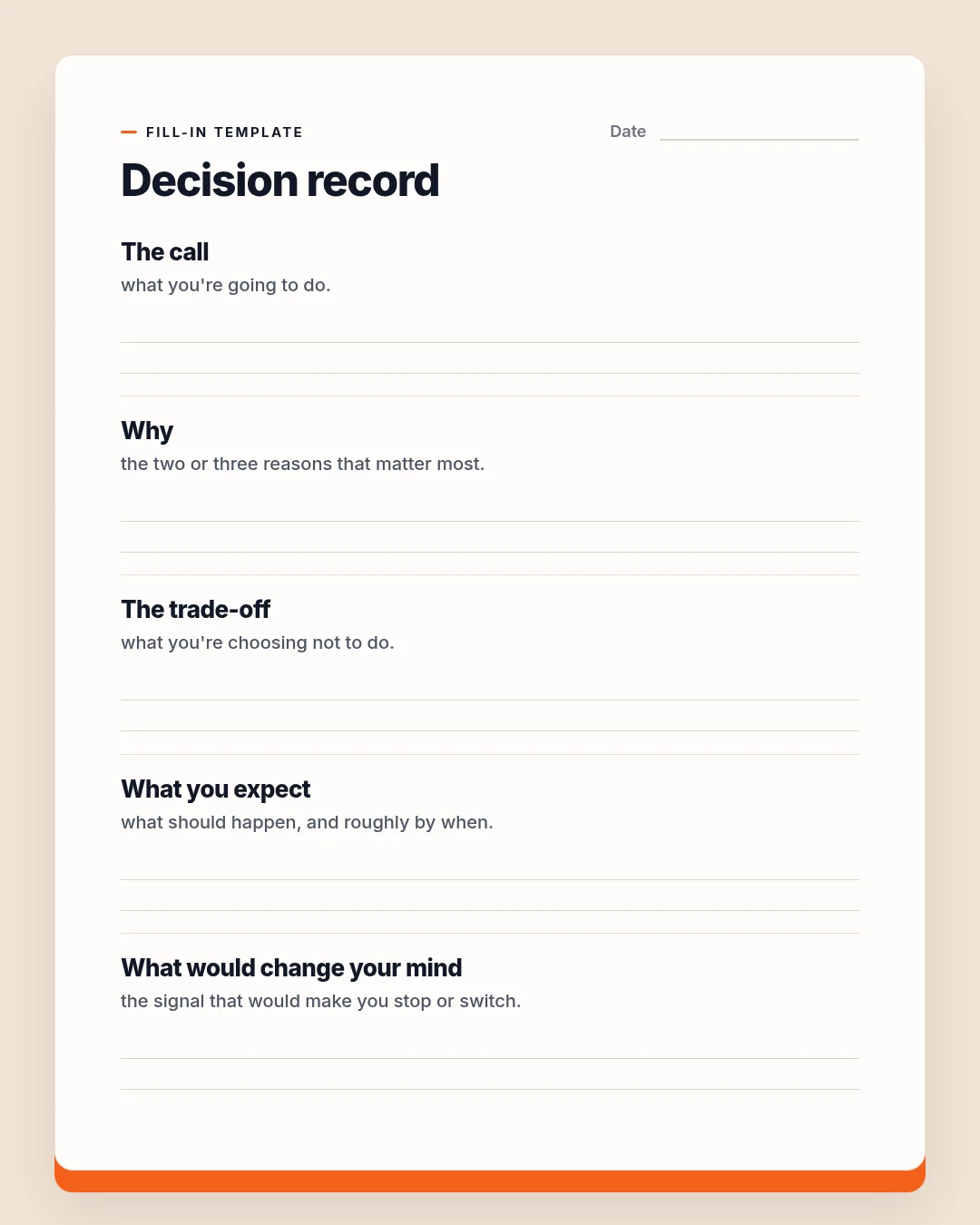
Writing it first matters because memory is generous. Once you know the outcome, it’s very easy to believe you saw it coming. A record dated before the result keeps you honest.
Here’s the difference in practice. This example is illustrative.
An undocumented recommendation:
I think we should move some of the paid social budget into a webinar this quarter. Webinars have worked well for us before.
The same recommendation, made explicit:
Call: Use a capped portion of next quarter’s paid social budget to test one webinar for operations leads.
Why: Our last two webinars produced booked demos at a lower direct cost than recent paid social campaigns. That makes a targeted test worth running, though some attendees may have been introduced to us via those paid campaigns.
Trade-off: We reduce paid social presence and commit marketing and sales hours to event production and follow-up.
Expect: At least as many booked demos per dollar as paid social delivered last quarter, within six weeks of the event, with comparable sales acceptance.
Change my mind if: Registrations are under half of our previous webinar’s benchmark at the two-week mark. Review audience fit, offer, and distribution before committing the remainder of the budget.
The first version isn’t wrong. It just can’t be checked. The second can, and that’s what lets you learn from it either way.
Step 2: Check it, especially when you were right
Put a date in your calendar when you write the record. When it comes up, read it and answer three questions:
- Did it happen the way I expected?
- What evidence supports my explanation? What else could explain the result?
- What would I write differently next time?
That second question is where most of the learning is. A campaign can succeed for reasons that have nothing to do with your plan. Attribution lag is a common one: a webinar can look like it outperformed paid social, when some of those demos started with an ad weeks earlier and only converted after the event. Seasonality can do the same thing, or a competitor going quiet. If you count that as proof your reasoning was right, you’ll repeat the reasoning somewhere it doesn’t hold.
The check isn’t only about the numbers on a dashboard. A customer interview that contradicts your assumption, sales pushback on the leads, or a fulfillment bottleneck after a spike in demand can all be reasons to revise the call, even if the report still looks fine.
Keep the records in one place, a doc or a spreadsheet tab is fine. After a few months, read them in one sitting. Patterns show up that you’d never spot one call at a time: maybe you’re usually right about audiences and usually wrong about timelines. That’s specific enough to work on.
Step 3: Borrow other people’s reasons, not their answers
The other half of getting better is to see how people who’ve been around longer reason, not just what they decide.
When a manager, a client or a senior colleague makes a call you wouldn’t have made, ask about the reasoning instead of the answer:
- Instead of “What should I do here?” ask “What would you look at first to decide this?”
- Instead of “Why did we pick that agency?” ask “What made this agency the best fit, and what compromises did we accept?”
- Instead of “Is this good?” ask “What would make you say no to this?”
The answer to “what should I do” helps with this one decision. The answer to “what would you look at first” helps with the next twenty.
When the call has already been made, ask, “What did you look at first when making that decision?”
Next time your manager has a decision to make, write down what you’d decide before they do, then compare. Compare the information, assumptions, and trade-offs behind each call. Work out what explains the difference.
Show the decision, not just the results
When you write up a project for a portfolio or talk about it in an interview, the decision record is a useful outline for the case study. It isn’t a substitute for context, your individual contribution, or the execution details. Results show that something worked. The call, the reasons, the trade-off, and what you learned help a hiring manager assess how you might approach their problems.
You don’t need a big win for this. A call that didn’t work, with an honest account of why and what you changed, can show more than a success you can’t explain.
If you give the “use your judgment” feedback
If you’re the one giving this feedback, you can make it something people can act on. Point to the signal that’s missing:
- “You waited for sign-off on something you could have decided.” (Making the call.)
- “I couldn’t tell why you chose this over the alternative.” (Saying why.)
- “You didn’t mention what this costs us.” (Naming the trade-off.)
- “The numbers changed and the plan didn’t.” (Updating.)
Each of those tells someone what to practise. “Use your judgment” on its own doesn’t.
What to do next
- Pick one call you’re making this week and write the five-line record before you act on it.
- Put a check-in date in your calendar for when the result should be clear.
- Ask one senior person, “What did you look at first when making that decision?” about a call they made recently, and write down what they say.
- If you give this kind of feedback, pick one piece of work this week and name the signal that’s missing, instead of saying “use your judgment.”
Better calls don’t arrive all at once. They build up one checked record at a time, and the file is how you see that it’s happening.